
Buttons
Shirt and garment buttons in polyester, shell, horn tone, coconut, metal and fabric, plus snap and jeans button hardware.
Also called garment buttons, shirt buttons.
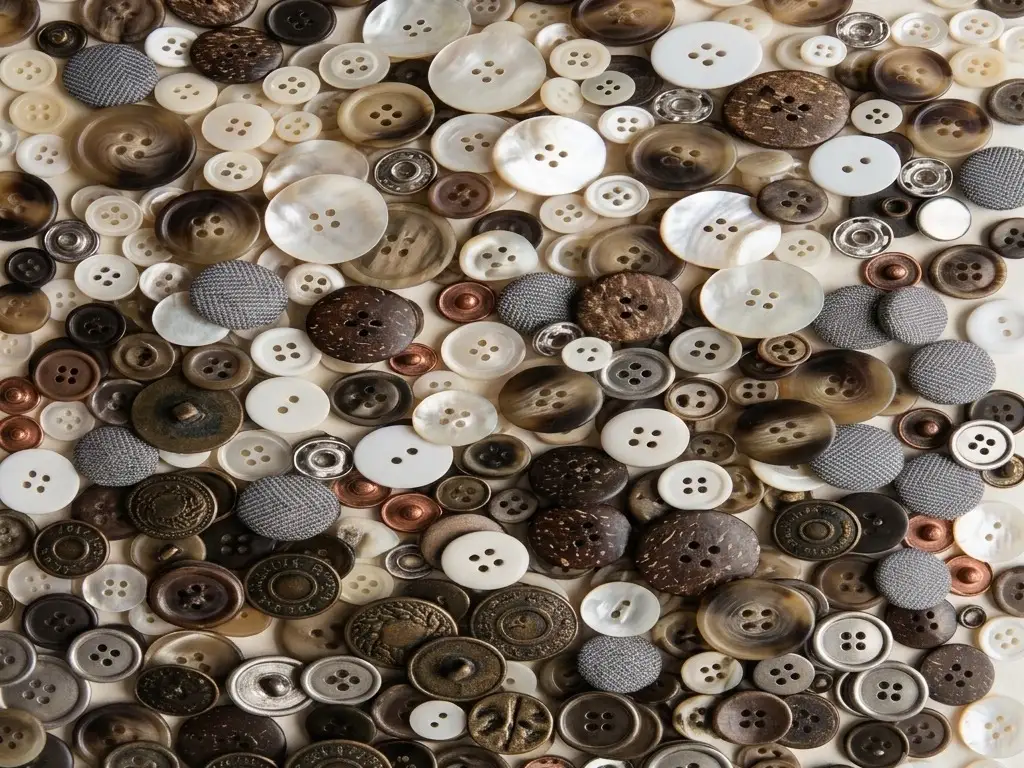
11 items in Buttons
-
Polyester Buttons
Moulded from polyester resin, the most widely used material for shirt buttons.
Also called resin buttons
-
Imitation Shell Buttons
Polyester buttons finished to imitate the layered lustre of natural shell.
Also called imitation MOP buttons, artificial shell buttons
-
Imitation Horn Buttons
Polyester buttons finished with the mottled brown tones of natural horn.
Also called artificial horn buttons
-
Shell Buttons
Buttons cut from natural shell, each face carrying its own grain and lustre.
Also called mother of pearl buttons, MOP buttons
-
Coconut Buttons
Buttons cut from coconut shell, with a matte natural surface and visible grain.
Also called coconut shell buttons
-
Snap Buttons
Two part press fasteners that close by pressing the halves together.
Also called press buttons, snap fasteners, ball and socket buttons
-
Chalk Buttons
Opaque matte buttons with a flat, chalk like surface finish.
-
Jeans Buttons
Metal tack buttons fixed through denim at the waistband.
Also called tack buttons, denim buttons
-
Metal Buttons
Buttons formed in metal, used where a harder wearing or heavier fastening is wanted.
-
Metal Rivets
Two part metal rivets set at pocket corners and stress points to reinforce them.
Also called jeans rivets, burr rivets
-
Fabric Buttons
Button blanks covered in fabric so the fastening matches the garment.
Also called covered buttons, cloth buttons
Natural or imitation, which should you order?
The usual decision is natural material or an imitation of it. Natural looks alive and no two pieces match. Imitation is polyester finished to look the same, and it repeats exactly across a big order. Neither is better. It depends on the garment and how consistent the batch has to be.
| Material | What it is | How it looks | Across a large order |
|---|---|---|---|
| Polyester | Moulded polyester resin | Even colour, any shade | Repeats exactly |
| Imitation shell | Polyester finished like shell | Pearly, layered sheen | Repeats exactly |
| Shell | Cut from natural shell | Every face has its own grain | Varies naturally |
| Imitation horn | Polyester finished like horn | Mottled brown, warm | Repeats exactly |
| Coconut | Cut from coconut shell | Matte, visible grain, speckled | Varies naturally |
| Metal | Formed metal | Hard, bright or antique | Repeats exactly |
| Chalk | Opaque matte finish | Flat, no shine | Repeats exactly |
Not sure which suits your garment? Send us the fabric and the price point and we will tell you what we would use.
Questions buyers ask about buttons
- What size button do I need?
- Buttons are measured in lignes, written L. Forty lignes make one inch, so a 20L button is about 12.7 mm across. Shirt fronts are usually 18L to 20L and sleeves 16L to 18L. If you are unsure, measure your old button across the middle in millimetres and tell us the number.
- What is the difference between shell buttons and imitation shell?
- Shell buttons are cut from natural shell, so every button has its own grain and lustre and no two are identical. Imitation shell is polyester finished to look like it, which gives a more uniform appearance across a large order. Which one suits you depends on the garment and how consistent you need the batch to be.
- How many holes should a shirt button have?
- Four holes is the standard for shirt fronts and cuffs because it holds better through washing. Two hole buttons are used where a flatter, plainer look is wanted. Shank buttons, with a loop behind instead of holes, are used on thicker cloth so the button sits above the fabric.
Ask about buttons
Tell us the item and the quantity. A photo of the trim or the garment helps most.
-
Param P Hirani
-
Praveen J Hirani
Prefer to write it out? Send an enquiry and we will reply to your phone or email.
This page was last checked by MG Corporation, garment accessory traders in Chennai since 1969, on .